cdb-news
- Prof Claudio Stern awarded one of seven Advanced Grants from ERC
- Prof David Becker nominated for BBSRC Innovator of the Year Award
- Young Embryologist Network Meeting
- Prof Lewis Wolpert at the world's only Philosophy Festival
- CDB PhD Student wins two prestigious awards
- Prof Christopher Dean wins Excellence in Medical Education Award
- Prof Steve Wilson interviewed in 'Development'
- CDB Scientists discover sense of direction is innate
- CDB Scientists discover genes 'decide who wins body’s battle with cancer'
- Cells’ grouping tactic points to new cancer treatments
- Prof Geoff Burnstock wins two prestigious awards
- The secret life of cells revealed
- Dr Greg Campbell wins UCL teaching award
- Dr Samuel Lee warns that women are risking their lives in pursuit of a child
- Head of CDB elected President of the International Society for Developmental Biology
- CDB scientist awarded prestigious Developmental Neurobiology prize
- CDB research highlighted in Emmy award-winning National Geographic film
- New funding for research into the genetic causes of Parkinson's, awarded to CDB
- Prof Steve Hunt prestigious Lifetime Achievement Award for Neuroscience
- Prof Claudio Stern interviewed on the implications of US stem cell funding ban lift
- CDB students win UCL Graduate School Research Poster Competition
- Reptile fossil reignites debate over New Zealand’s submergence
- CDB scientists identify mechanism behind brain asymmetry
- CDB Students win Prizes in UCL Graduate School Competition
- Antisocial, invasive cells cause secondary tumours, say UCL scientists
- Jurassic turtles could swim
- Scientists gain insight into motor neurone disease
- Neuroscientist receives international prize for ‘pioneering work’
- Prof Claudio Stern elected FRS
- Spirals shape how we think
- Found: The frog from hell
- How insulin could reduce scarring
- CDB New Grants Success
- CDB Professor appointed Sainsbury Wellcome Centre: Interim Director
- Crucial sex hormones re-routed by missing molecule
- Prof Zeki on how a blind man 'sees' the world
- Love: it’s all the same to the brain
- Prof Semir Zeki on BBC World Service 'The Forum'
- 2011 Young Embryologist Network Meeting - all welcome
- Zebrafish lab wins two Wellcome Image Awards
- UCL voted best place for postdocs to work
- CDB wins 1st prize in UCL Graduate School Competition
- Prestigious Beddington Medal awarded to CDB graduate Carlos Carmona-Fontaine
- Fossil Specimen is the "oldest pregnant lizard we have seen" says Prof Susan Evans
- Used postal stamps collection for the Leprosy Mission
- Sainsbury Wellcome Centre granted planning permission
- Salinas lab findings on halting Alzheimer's disease in mice published in Journal of Neuroscience
- CDB grad student Andrew Beale wins 1st prize in UCL Poster Competition
- CDB welcomes new arrivals
- 4th Young Embryologist Meeting set for June 1st
- CDB PhD Students Wins First Prize in Biosciences Research Poster Competition
|
CDB Seminars Thursday 23 May at 1pm __________________________ Thursday 30 May at 1pm
|
Crucial sex hormones re-routed by missing molecule
30 November 2010
A hormone responsible for the onset of puberty can end up stuck in the wrong part of the body if the nerve pathways responsible for its transport to the brain fail to develop properly, according to research by CDB funded by the Biotechnology and Biological Sciences Research Council (BBSRC).
|
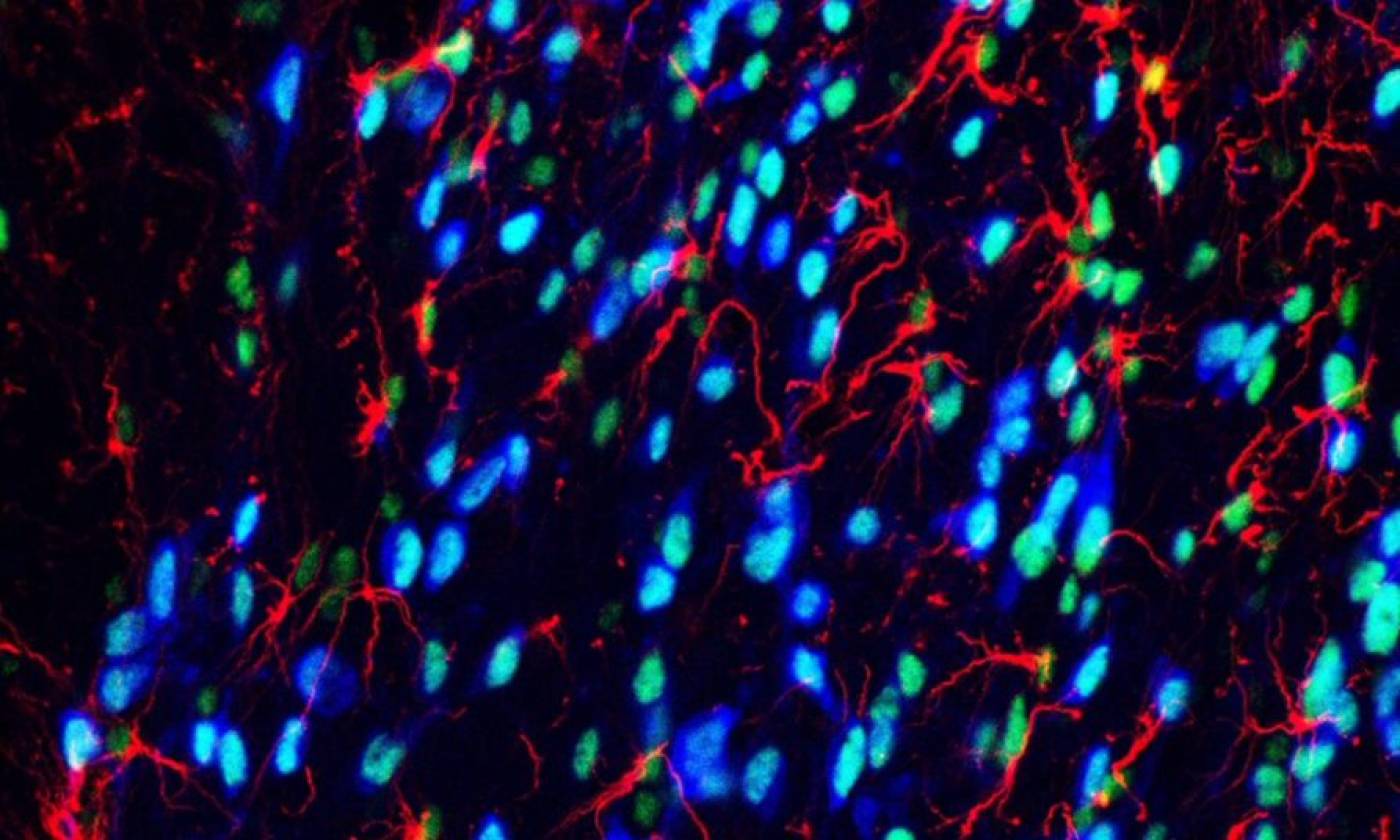
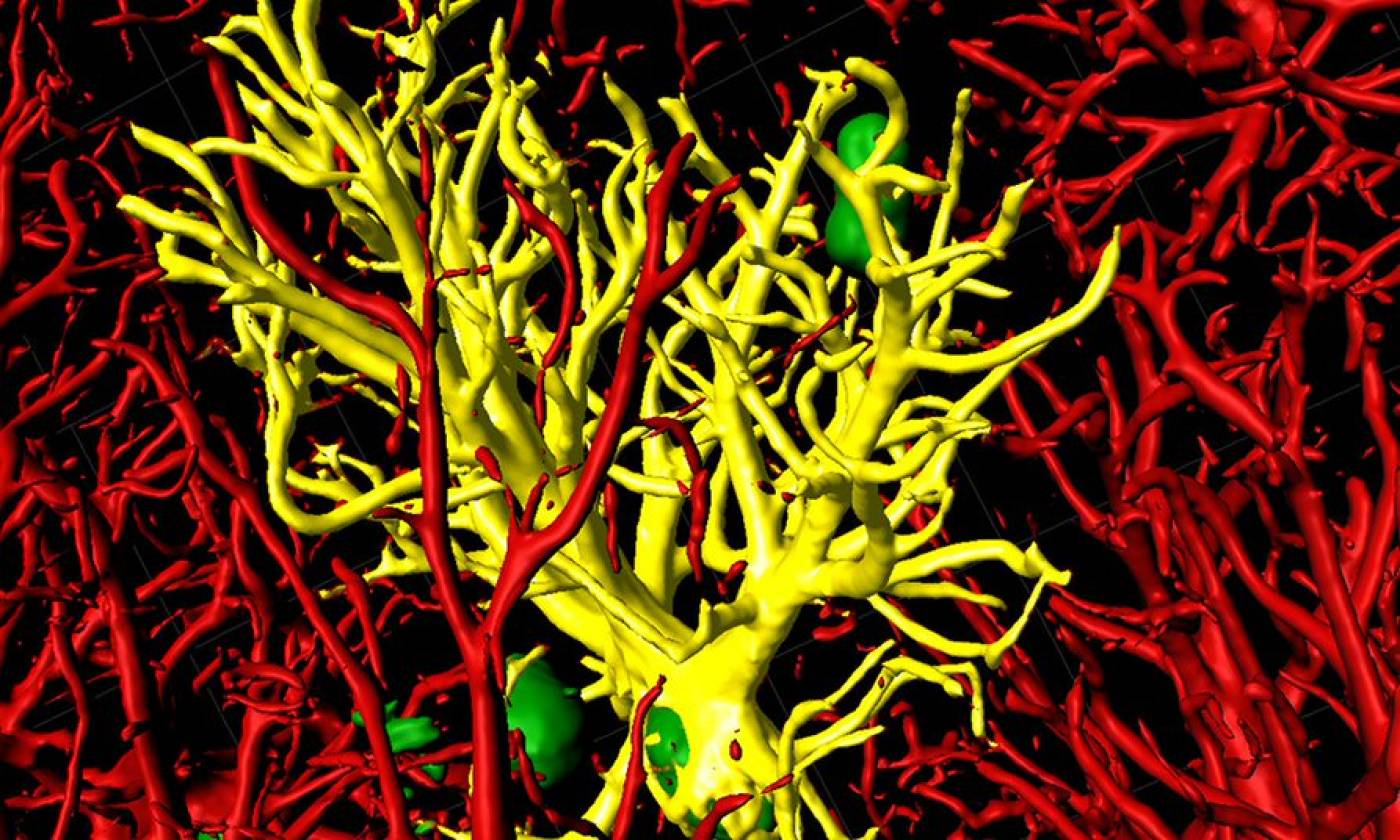
A research team from Prof John Parnavelas' lab in CDB showed that an optical section through a normal mouse nose showing the route the
nerve cables (yellow) normally transport the GnRH through the nose (blue). The
red shows the corridor inside the nose through which the nerve cables like to
travel. Image: Dr Anna Cariboni. |
By tracking how nerve cells responsible for regulating sexual reproduction in mice find their way from their birth place in the foetal nose to their site of action in the adult brain, scientists from University College London (UCL) have found that if a certain molecule is missing, then these pathways are not formed correctly and gonadotropin releasing hormone (GnRH) can become lodged in the nose or the forehead, rather than in the brain, where it is needed to control the menstrual cycle in females and testosterone production in males.
Speaking about the findings, published today (29 November) in Human Molecular Genetics, co-investigator Dr Christiana Ruhrberg explains: "We discovered that a molecule essential for the growth of the nerve cables that transmit odour and pheromone signals from the nose to the brain is also crucial in the development of the highways responsible for transporting other nerve cells that make the sex hormone GnRH. We found that in mice with an inherited deficiency in the molecule SEMA3A, these highways did not lead to the brain, but instead formed impenetrable tangles outside the brain. This means that the nerve cells making GnRH are unable to get to their final destination and instead become stuck in the nose or forehead."
As a result the researchers found that the testes of mice lacking SEMA3A did not grow properly and the adult males were infertile. These findings have important implications for the study of Kallmann's syndrome and related genetic disorders that causes infertility.
Professor Douglas Kell, BBSRC Chief Executive said "This study highlights the importance of understanding the very earliest developmental processes of the brain, including how and where cells develop, how they migrate and how and where they mature. Such fundamental bioscience research helps drive medical advances by providing clues about the development of a variety of disorders which present huge challenges to individuals, their families and our wider society."
Page last modified on 20 may 10 14:52 by Glenda Young